Checkout closed · verification in progress
Run Python where it fits.
PyRe plans, admits, and supervises local Python workloads across explicit CPU and NVIDIA CUDA lanes. It records what ran without pretending ordinary CPU code became GPU code. Intel XPU and AMD ROCm probes are included for future compatibility work, but the current packaged desktop cannot schedule those backends.
CPU is the conservative default for ambiguous work.
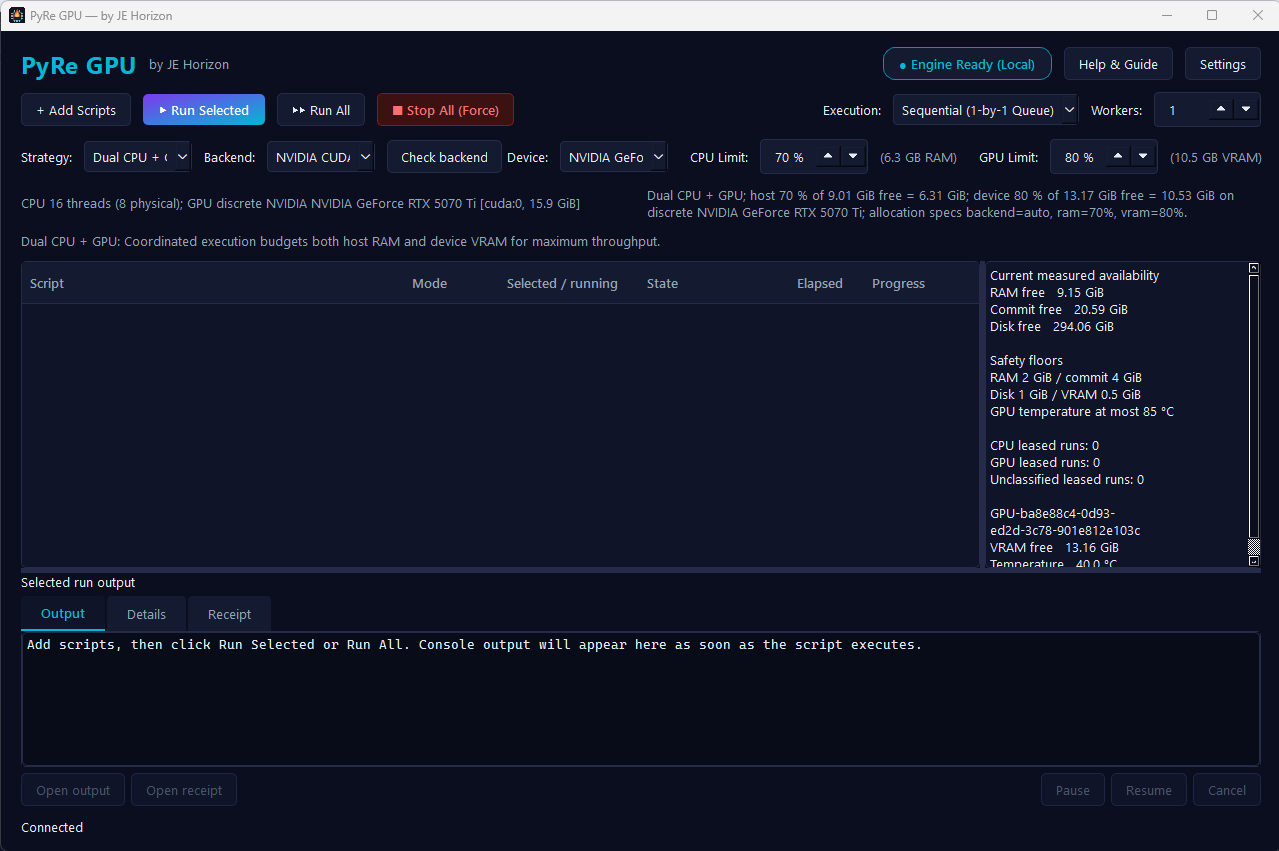
Native Windows Desktop Controller
Run scripts sequentially or in parallel with real-time CPU/GPU allocation limits, live execution status, and atomic run receipts.
Evidence before acceleration.
PyRe separates requested mode, selected backend, physical device, output parity, and elapsed time. A framework import alone is not a result.
- Windows x64
- Protected CPU and PySide6 host acceptance passed on CPython 3.10–3.13.
- Measured CUDA
- Actual CPU/CUDA execution, recovery, and output parity passed on an NVIDIA GeForce RTX 5070 Ti.
- Private delivery
- The protected artifact passed private Hugging Face download byte-parity verification. Public purchase and download remain closed.
For the final 256 × 256 matrix test, CPU was faster: median A was 0.3938 ms on CPU and 0.5163 ms on CUDA; median B was 0.3339 ms and 0.4785 ms. CUDA total time includes initial synchronization, host-to-device transfer, kernel work, and device-to-host transfer. This small workload is evidence, not a general speedup claim.
Designed support and verified support are different.
| Lane | Designed | Verified for this release |
|---|---|---|
| CPU | Standard Python and CPU framework workloads. | PASS · Windows x64, CPython 3.10–3.13. |
| NVIDIA CUDA | Explicit device-aware PyTorch workload. | PASS · RTX 5070 Ti. This is not every NVIDIA GPU. |
| Intel XPU | Interpreter and framework probing for future compatibility work. | REFERENCE ONLY · the current packaged desktop cannot schedule XPU; physical Intel hardware is NOT_CHECKED. |
| AMD ROCm | Interpreter and framework probing for future compatibility work. | REFERENCE ONLY · the current packaged desktop cannot schedule ROCm; physical AMD hardware is NOT_CHECKED. |
Intel XPU and AMD ROCm are not runnable product backends in this package. No OpenCL, DirectML, Vulkan, Apple GPU, universal GPU-model, or automatic Python-to-GPU claim is made.
Use the PyTorch installer selector for the current NVIDIA CUDA setup. The Intel XPU guide and AMD Windows support matrix are external references for future compatibility work; they do not make those backends runnable in the current package.
The workload chooses the real device.
- Prepare. Install the purchased PyRe wheel and matching framework in the selected interpreter.
- Configure. Set the absolute backend interpreter before the controller starts; confirm it in Settings.
- Check. Select the backend and physical device, then use Check backend.
- Run and prove. Inspect selected backend, output, receipt, parity, and transfer-inclusive timing.
Use the small CPU/GPU proof script. Set its BACKEND constant to cpu or cuda to match a runnable mode in the current packaged desktop. The script's xpu and rocm branches are generic framework references for future compatibility work; they are not modes the current packaged desktop can schedule. The CPU path needs no PyTorch. Accelerator paths allocate on the selected device and fail instead of silently using CPU.
For NVIDIA CUDA, run the commands below in PowerShell from the installed PyRe folder and set the interpreter before starting the controller. Do not substitute XPU or ROCM in this command for the current packaged release.
$env:PYTHON_GPU_CUDA_PYTHON = "C:\absolute\path\to\gpu-venv\Scripts\python.exe"
& ".\Launch PyRe.cmd"
$29 USD · one time
Pay once. Keep PyRe.
A purchase grants one customer perpetual use of the purchased application and compatible v1.x updates. No recurring subscription.
Questions before release
Does PyRe turn my script into GPU code?
No. Your script and framework must explicitly support and use the selected accelerator.
Does reaching the pending page mean I own a license?
No. Only a verified Stripe webhook can create the entitlement. Watch for the purchase email.
Can a customer download again?
A paid customer can request a fresh, short-lived email link for an entitled v1.x release. The public page never exposes the private artifact provider.
Where does my workload go?
Your selected scripts and their output stay local. Payment, transactional email, and gated artifact delivery use the providers named in the privacy notice.